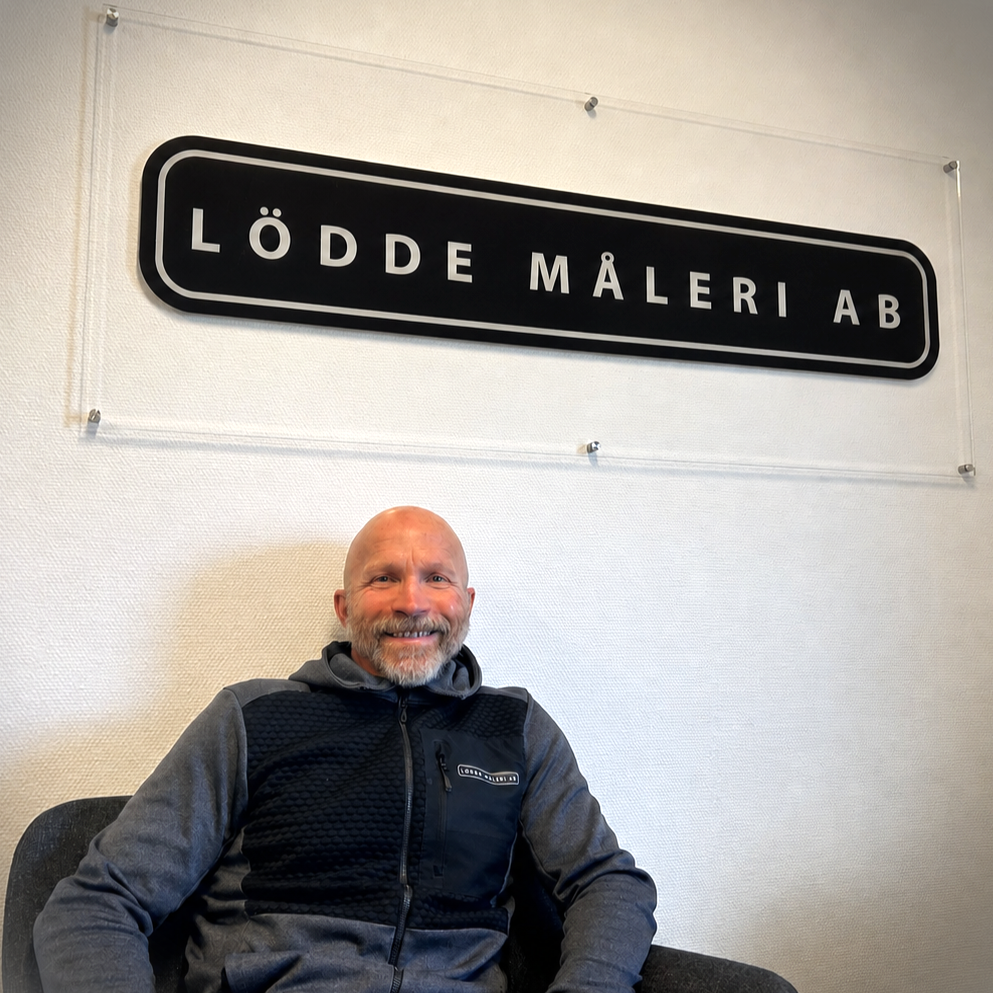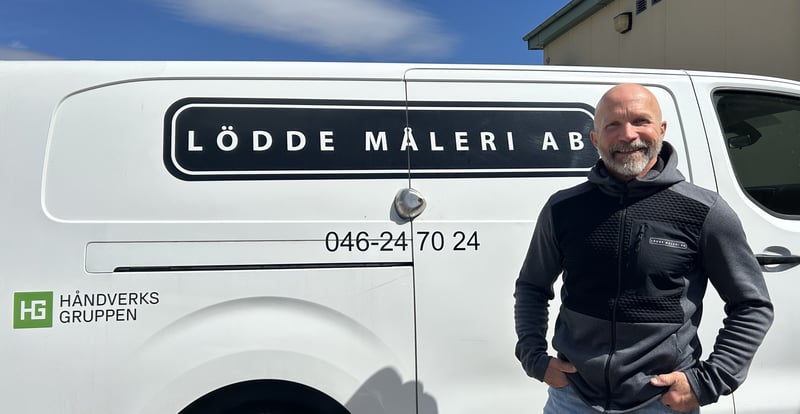
When the Swedish construction market started feeling the pressure again, many reacted as they usually do: they took on more projects, pushed prices down, and tried to keep up the pace. Order books had to be filled, and it was hard to be the one who said no.
At Lödde Måleri, they had already made their choice.
They had stopped doing new-build projects.
– We were losing money on it. They weren’t the right projects. So we said no, says General Manager Robert Nilsson.
It sounds simple, but in an industry where activity is often equated with survival, it is anything but an easy decision. Saying no also means saying no to revenue, growth, and the security of a full order book.
And yet, it is precisely that discipline that has shaped the company since Robert founded it in 2009.
A cowboy – without a polished plan
There was no real strategy in the beginning. No detailed growth plan.
– I didn’t have a finished plan from the start. It was mostly about making things work – and doing the job properly, says Robert.
He had worked as a painter for around 20 years, had been a supervisor, and knew the industry from the inside. When he started out on his own, it was mainly about keeping the work flowing. He drove around in his Volvo 855, took on the jobs that came in, and built the business through close contact with smaller construction companies and experienced painters he knew from earlier.
He describes it as being a “cowboy” – not unstructured, but close to reality, where experience carries more weight than plans on paper.
The company grew anyway.
From just a few employees to seven, then ten.
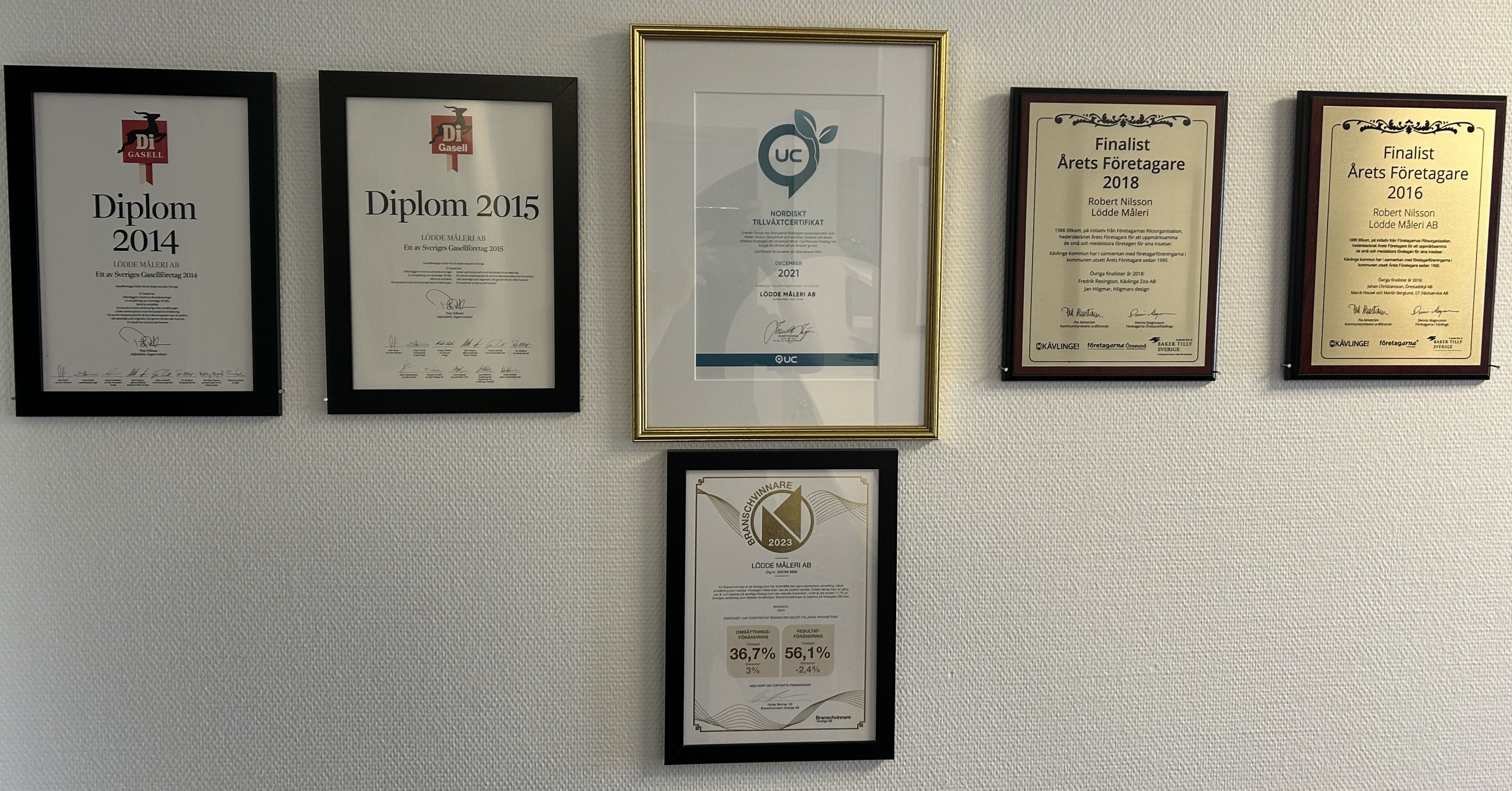
Later came larger projects, cost calculations, framework agreements, and municipal partnerships. At one point, things were moving so fast that Lödde Måleri was named a “gazelle company” by Dagens Industri.
As the company grew, more structure followed. Project management, service functions, and clearer roles made it possible to handle larger and more complex projects without losing oversight. It was not a break from the practical approach, but a way of scaling it.
But even in the years when growth accelerated, there was a limit.
They only took on what they could stand behind.
The line at new-build projects
That limit became clear with new-build projects. On paper, they were attractive: large assignments, high volume, and steady activity.
It was not new-builds as an area in themselves that were the problem. But in practice, the projects often turned out to have a risk profile and organisational setup that did not fit the way Lödde Måleri works. That is why they consciously opted out of this type of project, where they did not have the same control over process and finances.
– We can get the work done and keep people busy on those kinds of projects. But that doesn’t mean it’s good business, says Robert.
The decision to stop was not an adjustment. It was a deliberate deselection – and one that has since shown up in the numbers. Over the years, the company has maintained stable and healthy earnings, most recently in 2025 with a profit margin of more than 10 percent.
Choosing your business
Today, Lödde Måleri’s business is concentrated in four areas where they have control over both process and quality: the private market, property owners, public framework agreements, and renovation and conversion projects.
It is not about where there is the most work – but where the work can be carried out properly and efficiently.
Before they say yes to a project, they therefore assess it carefully: Who is the client? How is the project organised? Is the schedule and the different construction phases under control – or is the cooperation simply decided by the lowest price?
If the conditions are not there, they say no.
That decision is closely linked to another experience: that a large share of a project’s value only arises during the process – through changes, adjustments, and additional work. That is why it is crucial to enter the right projects from the beginning.
– There’s a lot that isn’t clarified from the start. If you don’t stay on top of it, you lose it, says Robert.
That is also why they do not work at a distance. Robert himself regularly visits the projects. Not to exercise control in the traditional sense, but to understand what is happening.
– You can’t manage it over the phone.
Every time he visits, he finds something that needs clarification. It may be a colour that does not match, a task that is not part of the agreement, or something that requires a decision before the work can continue.
These are not mistakes – they are part of the conditions.
Culture and responsibility in everyday work
This way of working also places demands on employees. Today they are around 35 people, and several have been with the company since the beginning. Continuity matters, because much of the work lies in what cannot be explained in a job description.
– You can teach most people how to paint. But it’s harder to teach a sense of responsibility. That has to come from the heart, says Robert.
That is why culture matters a great deal. The dialogue between management and employees is close, and relationships are prioritised – both in everyday work and through shared activities. When people know each other and trust each other, quality becomes higher – both internally and towards the customer.
As Robert says:
– It’s important that you take responsibility, even when no one asks you to. That you don’t just hand over a piece of work, but make sure it’s done properly. Ask the customer if they’re satisfied. Because that also means the customer remembers you and chooses you the next time.
Part of something bigger
In 2023, Lödde Måleri became part of Håndverksgruppen. For Robert, it was crucial that everyday operations could continue as before. That was also the message employees received when they were gathered and informed.
In practice, that is exactly what has happened. Projects are run the same way, with the same people and the same approach.
The main difference is that there are now other business owners to spar with. Experiences can be shared, and decisions can be discussed with like-minded people. In addition, they also borrow and lend manpower across HG companies in the region when projects require extra capacity or special expertise. This provides flexibility, allowing them to help one another without having to build internal overcapacity.
– It’s less lonely now than before, when I was the only one in my position. Now I’m part of something bigger. In the HG network, we have access to support, knowledge sharing, and companies in the area we can cooperate with. That gives us even better conditions for developing the business, he says.
The market changes continuously, and competition has increased, especially within renovation and conversion. But the fundamental approach remains the same.
They do not take on everything.
They choose.
And they still say no when the right conditions are not in place.
It is not always the easiest way to run a business. But it is the one that works for Lödde Måleri.