What happens when a practicing craftsperson suddenly has to direct — and has neither the words nor the tools for it?
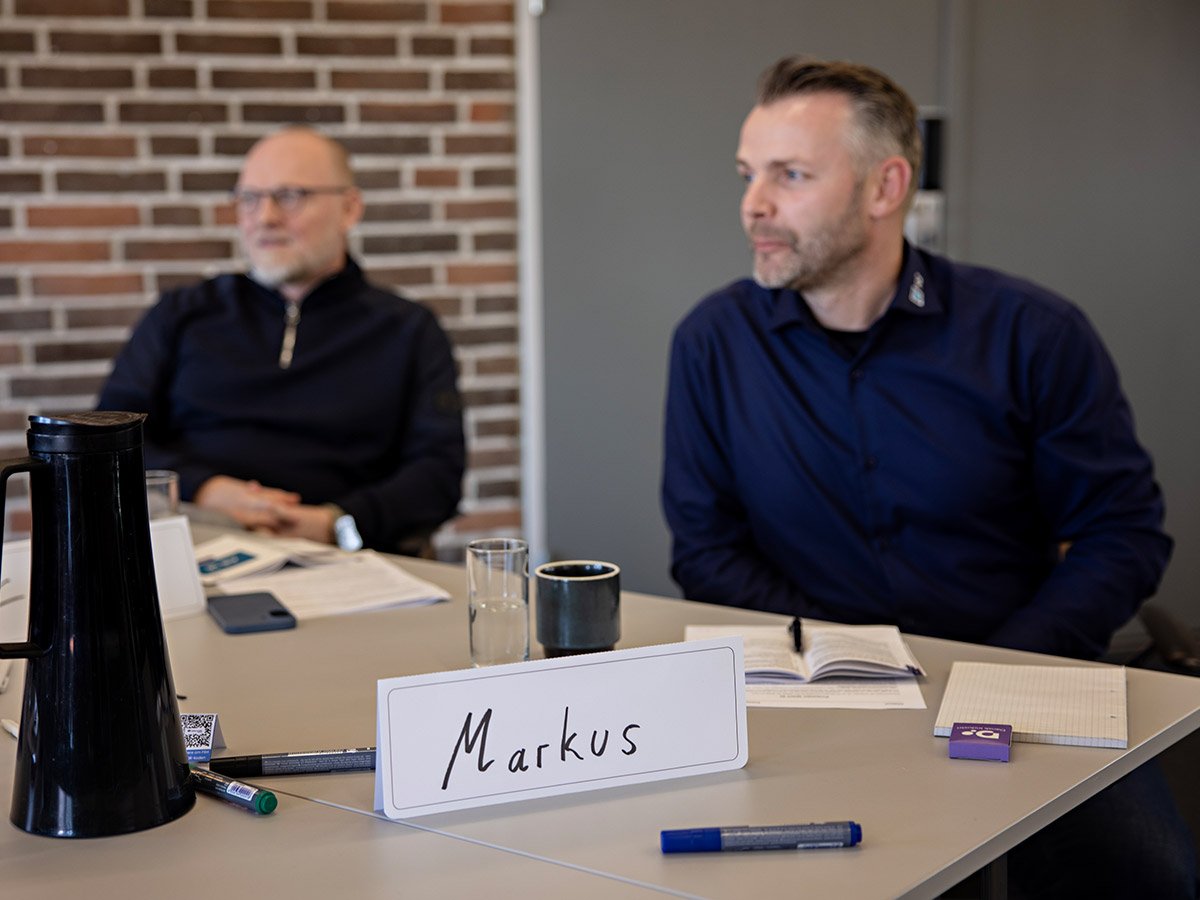
It was after the summer vacation, two years into his employment. Markus walked into the workshop like he always had — the faint smell of paint, the buckets stacked next to the door, the light seeping in from the side, making the paint dust visible in the air.
He looked towards the board. In the old days, there were tags there. One for each craftsperson, one for each assignment. You found your own, read the address, packed the car.
There was no tag for him.
For a brief second, he thought what he assumes most people would have thought: have I been fired? He didn't dwell on that for long. It was also a bit exciting. He went in to the general manager, Tue, and asked straight out what he was supposed to do.
The answer was a hospital project. And fifteen craftspeople to be managed.
— This management thing really just snuck up on me, Markus says now, many years later, from the office he has gradually slid into.
Executing, suddenly directing
At R2 Farver, one of the companies in Håndverksgruppen, Markus has gone from painting apprentice to a journeyperson to a manager without anyone ever sitting down and saying that now, «now you are a manager.» The promotions came like the hospital project did: as an empty space on the board, as a question of who could manage fifteen craftspeople, as an office chair with no name on it.
The difficult part wasn't numbers. It was delegation.
— Delegating didn't come naturally to me. After all, I've always been the one doing the work.
He was good at doing. Not at asking others to do. The difference is bigger than it sounds.
— There could be situations where I wasn't satisfied with the work others had done. In the beginning, I just did it over again, without saying anything first.
It took a couple of years to get used to. His boss, Tue, taught him quietly and calmly, Markus says — they became a great team. But even with a patient boss, it gnawed at him: how do you tell a grown professional that something has to be redone? How do you give instructions without becoming a boss in the worst sense of the word?
People are not the same
Somewhere along the way, it began to dawn on him that the recipe didn't exist. Or rather: that there wasn't just one recipe.
— You're dealing with craftspeople, and everyone is not the same, so you have to be adaptable enough to have a conversation that meets each individual where they are.
It sounds obvious. It isn't, when you are standing there on a Tuesday morning with a group of painters on a site and you notice that something isn't right.
— I've had a few times where there are 5–6 painters on site and the chemistry isn't there. Then you have to do something about it.
And the painting apprentice who has just become a journeyperson and is going out to the construction sites alone — that person needs something completely different from the experienced painter with twenty years behind them.
— It was difficult for her, and so I had to help her get started — stand a bit more on the sidelines to help and give advice.
The realization was uncomfortable and simple: he didn't have the language for this. He had hands, experience, respect in the industry. But not the words for the conversation that lay ahead of him every single week.