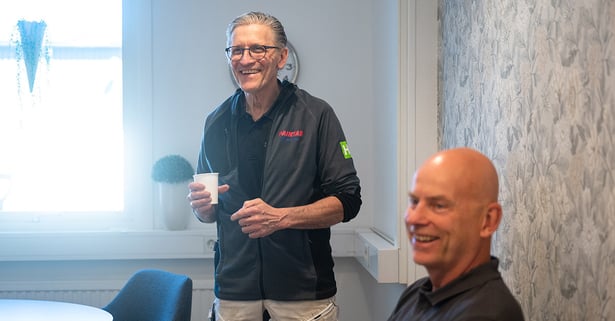
Markus returns from summer vacation.

Walks into the workshop to find his next assignment.

There is nothing for him on the board.

No address, no car to pack, nothing to paint.

Had he been fired?

4 MIN READ

Suddenly a boss


Suddenly a boss
7:34


What happens when a practicing craftsperson suddenly has to direct — and has neither the words nor the tools for it?

It was after the summer vacation, two years into his employment. Markus walked into the workshop like he always had — the faint smell of paint, the buckets stacked next to the door, the light seeping in from the side, making the paint dust visible in the air.

He looked towards the board. In the old days, there were tags there. One for each craftsperson, one for each assignment. You found your own, read the address, packed the car.

There was no tag for him.

For a brief second, he thought what he assumes most people would have thought: have I been fired? He didn't dwell on that for long. It was also a bit exciting. He went in to the general manager, Tue, and asked straight out what he was supposed to do.

The answer was a hospital project. And fifteen craftspeople to be managed.

— This management thing really just snuck up on me, Markus says now, many years later, from the office he has gradually slid into.


Executing, suddenly directing

At R2 Farver, one of the companies in Håndverksgruppen, Markus has gone from painting apprentice to a journeyperson to a manager without anyone ever sitting down and saying that now, «now you are a manager.» The promotions came like the hospital project did: as an empty space on the board, as a question of who could manage fifteen craftspeople, as an office chair with no name on it.

The difficult part wasn't numbers. It was delegation.

— Delegating didn't come naturally to me. After all, I've always been the one doing the work.

He was good at doing. Not at asking others to do. The difference is bigger than it sounds.

— There could be situations where I wasn't satisfied with the work others had done. In the beginning, I just did it over again, without saying anything first.

It took a couple of years to get used to. His boss, Tue, taught him quietly and calmly, Markus says — they became a great team. But even with a patient boss, it gnawed at him: how do you tell a grown professional that something has to be redone? How do you give instructions without becoming a boss in the worst sense of the word?
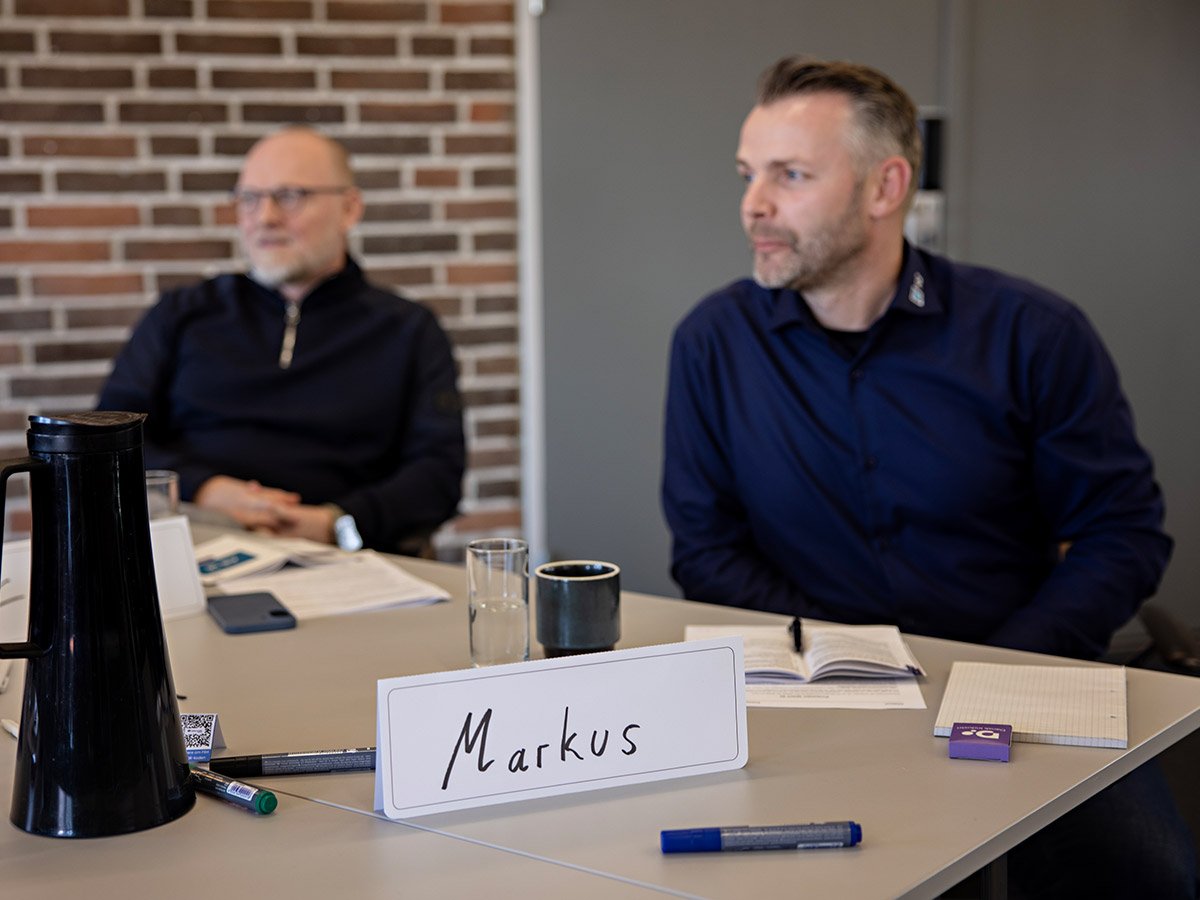
2025_Feature-HG-skolen_1

People are not the same

Somewhere along the way, it began to dawn on him that the recipe didn't exist. Or rather: that there wasn't just one recipe.

— You're dealing with craftspeople, and everyone is not the same, so you have to be adaptable enough to have a conversation that meets each individual where they are.

It sounds obvious. It isn't, when you are standing there on a Tuesday morning with a group of painters on a site and you notice that something isn't right.

— I've had a few times where there are 5–6 painters on site and the chemistry isn't there. Then you have to do something about it.

And the painting apprentice who has just become a journeyperson and is going out to the construction sites alone — that person needs something completely different from the experienced painter with twenty years behind them.

— It was difficult for her, and so I had to help her get started — stand a bit more on the sidelines to help and give advice.

The realization was uncomfortable and simple: he didn't have the language for this. He had hands, experience, respect in the industry. But not the words for the conversation that lay ahead of him every single week.

Money has to be brought in.

People have to be motivated.

Conversations have to be had in time.

None of these things were on the journeyperson's exam.

The tools came from the course

Industry figures say that there will be a shortage of around 90,000 craftspeople in the coming years. Very few of the new managers in the trade receive training before they are sitting in the boss's chair. Markus is one of them. The HG School's course «Tomorrow's Leader» became the answer he didn't know he was looking for.

— It was the leadership course that gave me an insight into what possibilities exist. When plan A is not good enough.

The course wasn't a series of lectures. It was a little bit of theory and mostly role-playing.

— We had Danny as a teacher. He created some role-plays we had to go through. About different situations, about what to do, and what you can be exposed to.

The role-plays were the way to practice. The tools had names. The DISC profile gave him a vocabulary for personality differences — who needs boundaries before starting, who needs to talk while they work, who wants to see that the boss believes in them before they trust themselves. Situational leadership is about the fact that the same manager has to meet the same employee differently, depending on where they are in the task right now. And the motivation curve describes exactly that — where the individual lies from start to finished work, so that you know when to «push» and when to let people work in peace.

The most crucial thing for Markus wasn't the personality profiles. He knew his own well enough. It was the motivation curve.

— Employees are very motivated when they are given a task. And further along, where they might not be able to stand by their work, that's where they lose their spark. And then we can find the motivation again — where we can just lift them up a bit, with those tools.

And the extra work — the construction industry's eternal pain point, where you have to claim every hour that falls outside the contract. That was where the role-play hit hardest.

— Then I have to stick to facts instead of feelings. 100 percent. That is something I have learned, and it is a part of the role-play we have had through this process.


Better equipped to meet demands from his own boss

The tools also work upwards. When Markus's own boss expects something that isn't possible, he now has something to lean on.

— Since I am somewhat more certain about my tasks, I am actually quite sure that I can stand by it even more.

— It gives me an even greater confidence that I can say no to something, because I am equipped for it.

— Then I can easily go in and say to my boss: this, this is the best we can provide.

The employees have noticed the difference. Not in grand words — they are painters, not HR people — but in a passing remark or two.

— I actually received a comment that they could tell I had grown quite a bit more with the tasks.

— Well, they basically said that it's really nice to see that I'm a bit more structured, and that outwardly I seem a bit more calm and settled when assigning tasks.

2025_Feature-HG-skolen_2

Course participants help each other afterwards

The HG School gave him something more than role-plays. It gave him someone to call.

The other day the phone rang. It was someone from another company in the group, someone he had sat with during the course, who was facing a personnel issue and needed someone to think out loud with. Markus listened, shared what he himself had learned, and hung up.

Other days he is the one dialing the number of a colleague from the course. An issue he doesn't quite know how to tackle. A question about how a colleague in a completely different trade would have handled it.

He looks out the window of his office. That's not where he saw himself when he stood with a paintbrush in his hand. And yet — when asked if he has become a different person because of this, he shakes his head.

— I haven't changed because of that, just because I sit here.

What he has changed, is his focus. Now he looks ahead in time.

— Before, I only discovered problems when they landed on my desk. By then it was already too late. Now I see them before they arise.


xx:


xx

xx